At the heart of Route is a hybrid travel survey that comprises three phases of data collection featuring passive tracking and survey questionnaires. This provides information needed understand peopleʼs travel habits and the posters and screens which they are exposed to.
Recruiting Participants
The participants in our travel survey are recruited face to face. This process is wholly managed by Ipsos. All participants opt into the survey and are aware of the data which is being collected. Participants are offered a small incentive to encourage the completion of the tasks. This is only paid upon completion.
The Sample
Each year c.7,000 adults aged 15+ participate in the research. These people are selected on the basis of their demographic and geographic distribution to ensure that over six months, our sample reflects the profile of the adult GB population in terms of demography and geography. The sample data is rolled up over multiple years to ensure that there is a sufficiently robust base of journeys to cover the whole country in sufficient depth. In total the Route data is based on a total of 25,420 people’s journeys. These were collected between the period of September 2017 – February 2020 and September 2022 to August 2023.
The Tasks
The first task is to complete the recruitment questionnaire. This is around a 15 minute process and includes a range of questions about the participant. This is used to ensure that they meet the correct criteria and that we are speaking with the right people. A copy of the demographic recruitment questionnaire can be seen here.
Secondly, participants agree to carry a passive tracking device with them, each time they leave the house for a two-week period. This “Multi-Sensor Tracker” (MST) will then capture their precise geo-location on a second-by-second basis using an advanced GPS chip.
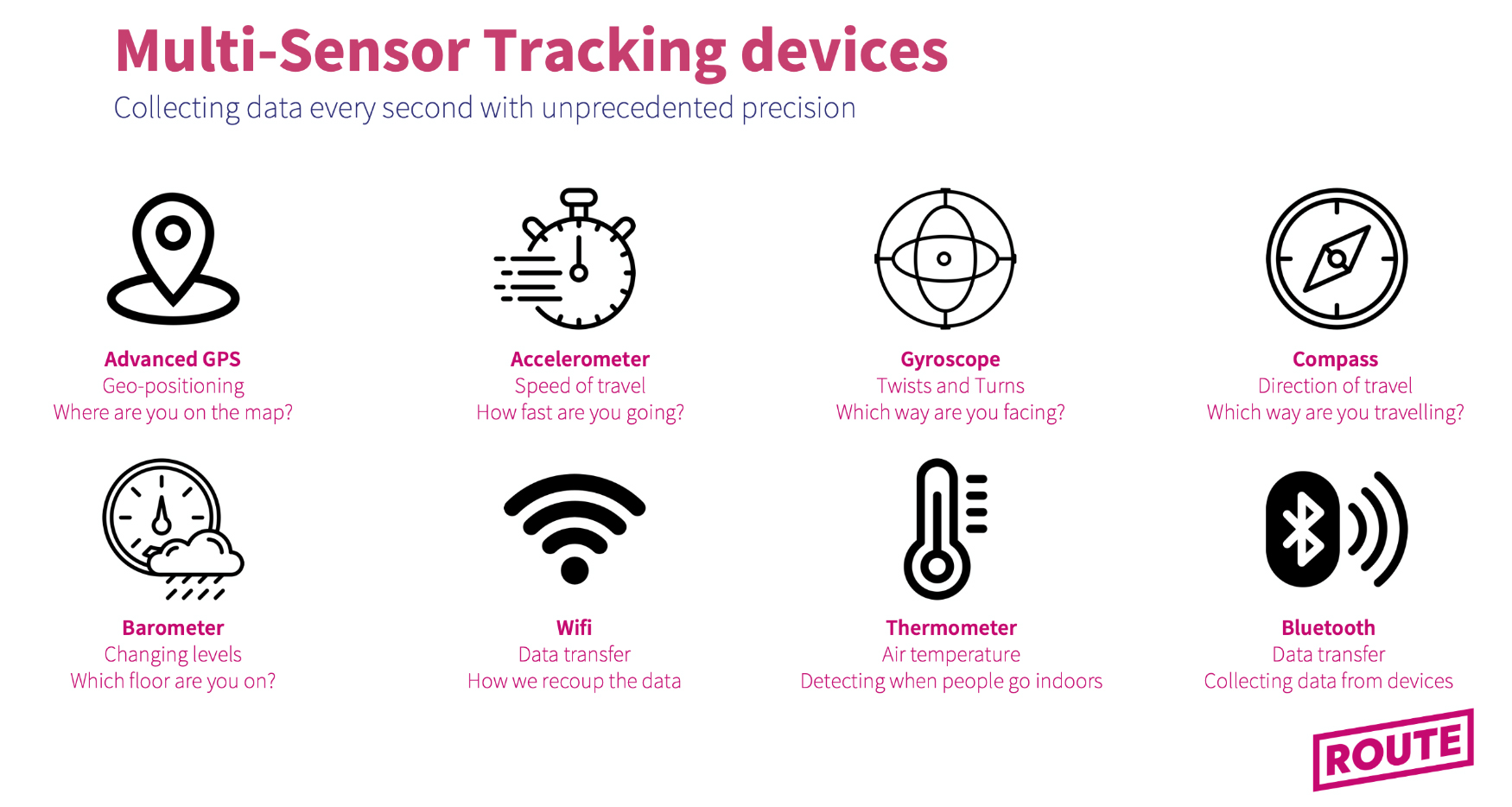
The device also houses additional sensors which provide further readings that can be used to interpolate the device’s whereabouts should the GPS signal be lost or if the signal strength drops. This is particularly useful in indoor environments such as underground stations, shopping malls and rail stations. The sensors which provide the additional readings are the Accelerometer, Gyroscope, Magnetometer and Barometer.
The final part of the travel survey is for participants to complete a pen and paper questionnaire (PAPI) which is left with them by their interviewer and is then retrieved at the end of the two-week period when the MST device is collected. This questionnaire focuses more on people’s lifestyles, interests and attitudes.
What we collect
Every journey which participants make is recorded giving us information on the exposures people have to out of home advertising. We use this data to construct our key audience measures and establish how likely they would have been to notice the ads that they were exposed. The journey traces determine not only the ads that people are exposed to, but for how long, and where they are positioned relative to the ads in order to calculate the probability that the ad will have been seen.
All of the profiling variables collected from the two questionnaires can be combined in analysis of the data to create target audiences.
Corrective Data Weighting
Route uses JICPOPs as it’s source of population estimates and uses this as our research ‘universe’. Sample quotas are set to match the population distribution according to JICPOPs. This data is updated annually and with this refresh, Route also updates the population target at this frequency.
Any corrective rebalancing which are required to ensure that our sample reflects the total Great British adult population aged 15+ are achieved through a weighting process. This requires that each person within our sample is assigned a population weight based on their sex, age, social grade, region (Postcode area) and working status.
Summing all population weights for all participants will tally to the total population according to JICPOPs.
The outcome
The outcome of all this is a dataset which enables Route to report on the total audience for around 400k posters and screens in Great Britain. It can estimate how many individuals will see OOH campaigns, the total number of times it will be seen and also who is most likely to have seen it.